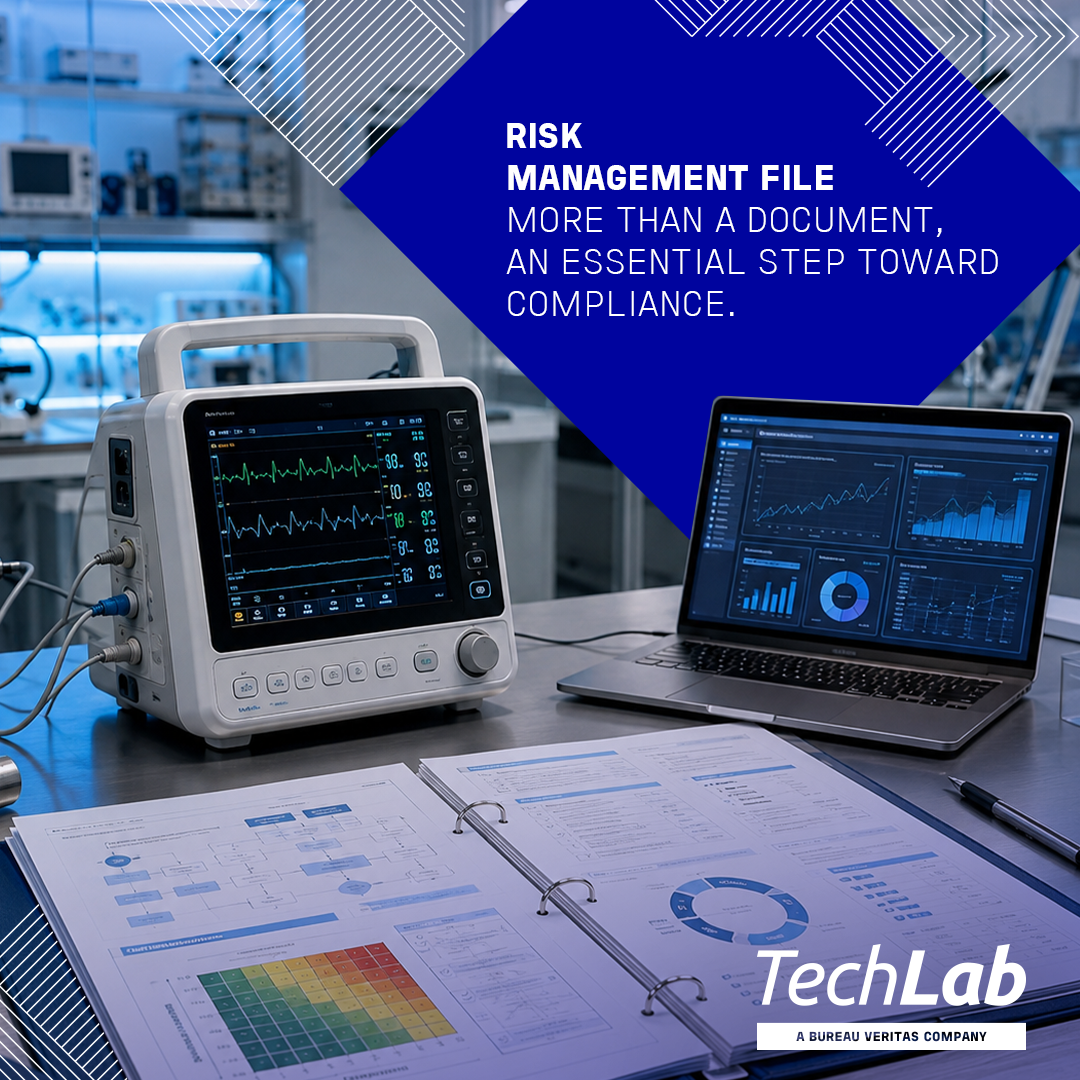
Risk Management File - More than a document, an essential step toward compliance.
Risk Management File (RMF): Why Is It Essential for IEC 60601-1 Compliance?
In the development of medical devices, manufacturers often focus their efforts on passing the laboratory tests required by IEC 60601-1, the international standard that establishes basic safety and essential performance requirements for medical electrical equipment. However, one point frequently raises questions during certification processes: testing alone is not sufficient to demonstrate product safety.
IEC 60601-1 adopts a risk management-based approach, requiring manufacturers to identify hazards, assess potential harm, implement risk control measures, and demonstrate that residual risks remain acceptable. To this end, the standard refers to ISO 14971, the primary international standard for risk management of medical devices.
This is where the Risk Management File (RMF) comes into play. It is the document that compiles all information related to the identification, analysis, evaluation, control, and monitoring of risks associated with the product throughout its life cycle. More than a documentation requirement, the RMF provides evidence that safety has been considered from the earliest stages of product design and development.
In practice, manufacturers must assess a wide range of risks that may affect patients, operators, and third parties. These include risks of electric shock, mechanical failures, excessive heating, unwanted radiation, software-related issues, foreseeable use errors, and failures of critical components. Each identified hazard must be analyzed in terms of its probability of occurrence and the severity of its potential consequences.
Following this assessment, risk control measures must be defined and implemented to reduce risks to acceptable levels. These measures may include design modifications, protection systems, alarms, physical barriers, instructions for use, or specific training. ISO 14971 establishes a hierarchy for these measures, always prioritizing inherently safe design solutions before relying on warnings or information provided to the user.
One of the most important aspects is that risk management does not end when the equipment is placed on the market. The process must be continuously updated based on information obtained during the manufacture, distribution, and use of the product. Customer complaints, field incidents, component changes, and software updates may require revisions to the RMF to ensure that risks remain adequately controlled.
During audits, certifications, and regulatory processes, assessors commonly request evidence demonstrating the relationship between IEC 60601-1 requirements and the risk analysis performed in accordance with ISO 14971. When the RMF is prepared consistently, manufacturers can justify engineering decisions, demonstrate the effectiveness of risk control measures, and significantly reduce technical questions during conformity assessment.
For this reason, the Risk Management File should not be viewed merely as a regulatory requirement, but as a strategic tool for developing safer, more reliable medical devices that meet the requirements of the global market. A robust RMF helps reduce rework, accelerate certification processes, and, most importantly, protect what matters most: patient and user safety.
In an increasingly demanding regulatory environment, understanding the integration between IEC 60601-1 and ISO 14971 is essential to transforming risk management into a competitive advantage and a true pillar of quality in medical devices.